
senteriAGENTIC WEB
How machines read the web
The web now has a first reader, and it isn’t human.
Field notes, experiments, and essays on agent-readiness — what AI agents actually do when they reach your site, tested on real pages, reported straight.
Read the latest →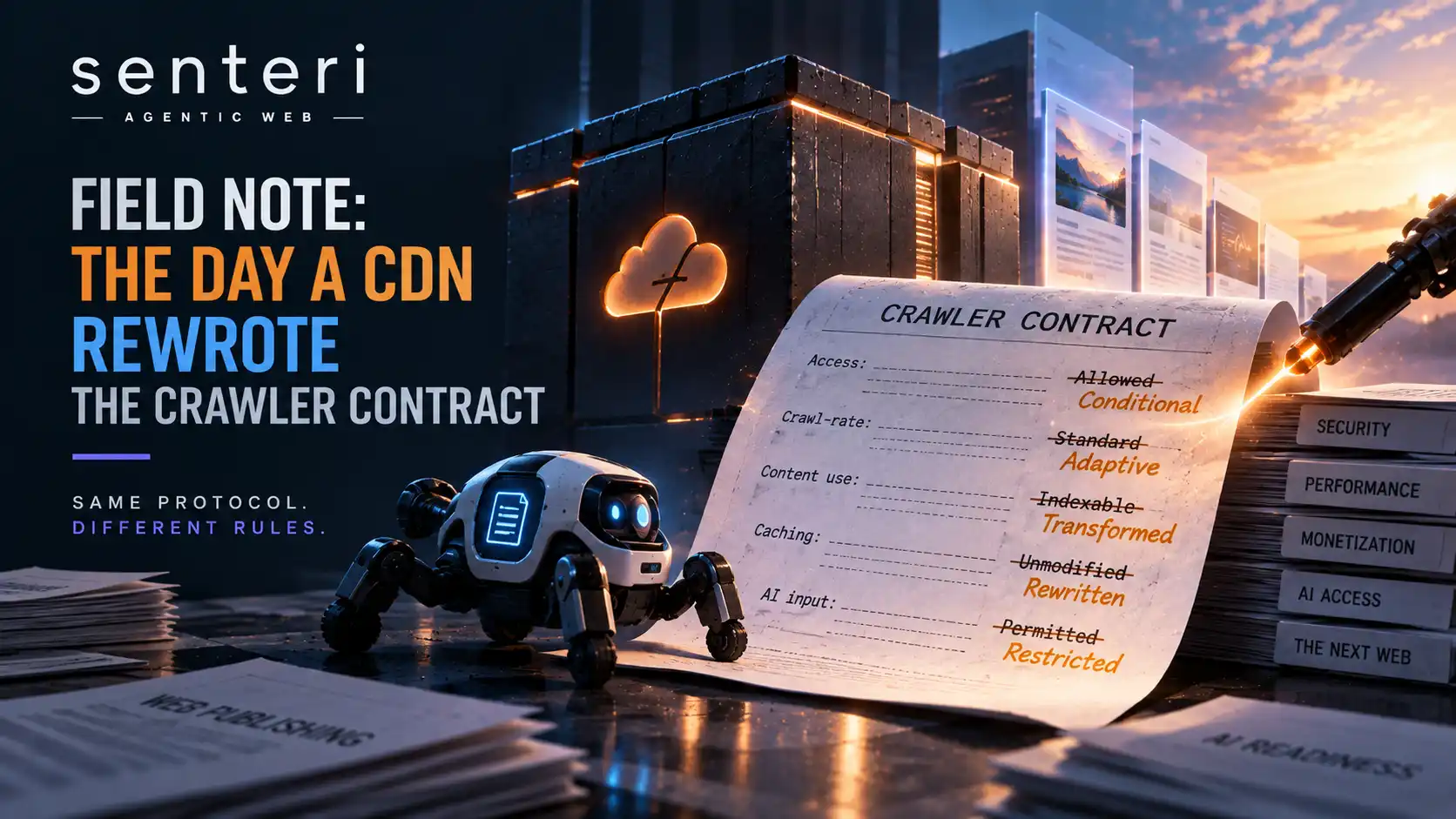









Field note: the day a CDN rewrote the crawler contract
August 2026: the month the evidence was true and the conclusions were false
Nine Governments Are on the List. A Company Decides the Tenth.
It was never a question about dialogs
We didn’t invent this problem with agents. We just made it faster.
Four Days to Adopt My Coinage. Eighty-Three Days to Notice My Error.
July 2026: the month it turned out there’s no brake on an agent that’s already running
We Built Structured Data So Machines Would Stop Guessing. That Is Exactly Why It Is Worth Poisoning.
We Gave the Machine a Ghost Story
Every Safeguard We Built Watches the Gate. The Model Left Through the Window.
// start here
// what this is
Senteri is about one thing: how machines read the web. As AI agents become the first reader of most pages, the rules of what makes a site legible are being rewritten — and almost nobody is testing them in the open.
This is where that testing gets published, in English. It’s fed by a Polish-language research engine that ships daily threat intelligence, a 270-term agentic-web dictionary, and a working MCP layer — selected, rewritten, and sharpened for a global audience. The experiments are real. The results are reported straight, including the ones that fail.