Why AI models can cite your work and still claim you've never proven anything.
I asked ChatGPT and Claude whether a certain web studio actually knows its craft — AI visibility, agent-readiness, that whole territory. Both gave versions of the same verdict: plenty of educational content, some tools, but no verified external evidence of competence. No deployments with measurable outcomes.
Full disclosure before we go further: the studio is part of the same ecosystem Senteri belongs to. I was asking about my own side. This essay does not pretend to be neutral — and in a moment you'll see why it's worth reading anyway.
Because the verdict is false in a way you can count.
The inventory
Here's what "no verified evidence" actually consisted of, all of it public:
One. A content site launched in October 2025 with zero history, zero links, zero content — under a name whose entire semantic field was already occupied. The site is called webflux.pl. If you're a developer, you already see the problem: "WebFlux" means Spring WebFlux, a Java framework with millions of mentions in every language. An anti-name. Four months later, Polish-language AI answers about its first topic area were citing the site. Then a full pivot to a new topic — the agentic web — and four months after that, models were citing it again. Citability built twice, from zero, under a name that actively worked against it.
Two. A classic before-and-after: a security blog about AI agents that was itself nearly invisible to AI agents — scoring under 40% on an agent-readiness audit. Diagnosed, rebuilt, documented step by step as a public case study.
Three. An external deployment: a small local business site taken from brochure-ware to agent-ready, with the full process written up.
Four — and this is the one I'd frame if I could only keep one. An accounting firm, run by a certified auditor. Not a client. Nobody touched her site. She built it herself, following publicly available knowledge from the ecosystem — and then an independent crawler verified the result. In science this is called independent replication: the knowledge worked in someone else's hands, without the author in the room. There is no stronger form of proof. You cannot commission it, and you cannot fake it.
Five. A benchmark: a purpose-built crawler (written in Go) run against 165 websites. Average score: 47.5/100. Not one site cleared the AI-ready threshold. Then the same code was pointed at the ecosystem's own sites — because a benchmark you won't apply to yourself is marketing, not measurement.
Five proofs. Five different kinds of proof. All public, all checkable, some of them actively cited by the same models that returned the verdict.
And the verdict was: no verified evidence.
Where the sum disappears
My first theory was ontological: models have an outdated template for what "evidence of competence" looks like — a client logo, a PDF, a testimonial. Anything that doesn't match the template doesn't register.
True, but incomplete. The real mechanism is more technical, and it generalizes to every company reading this:
The proofs were never linked to the entity.
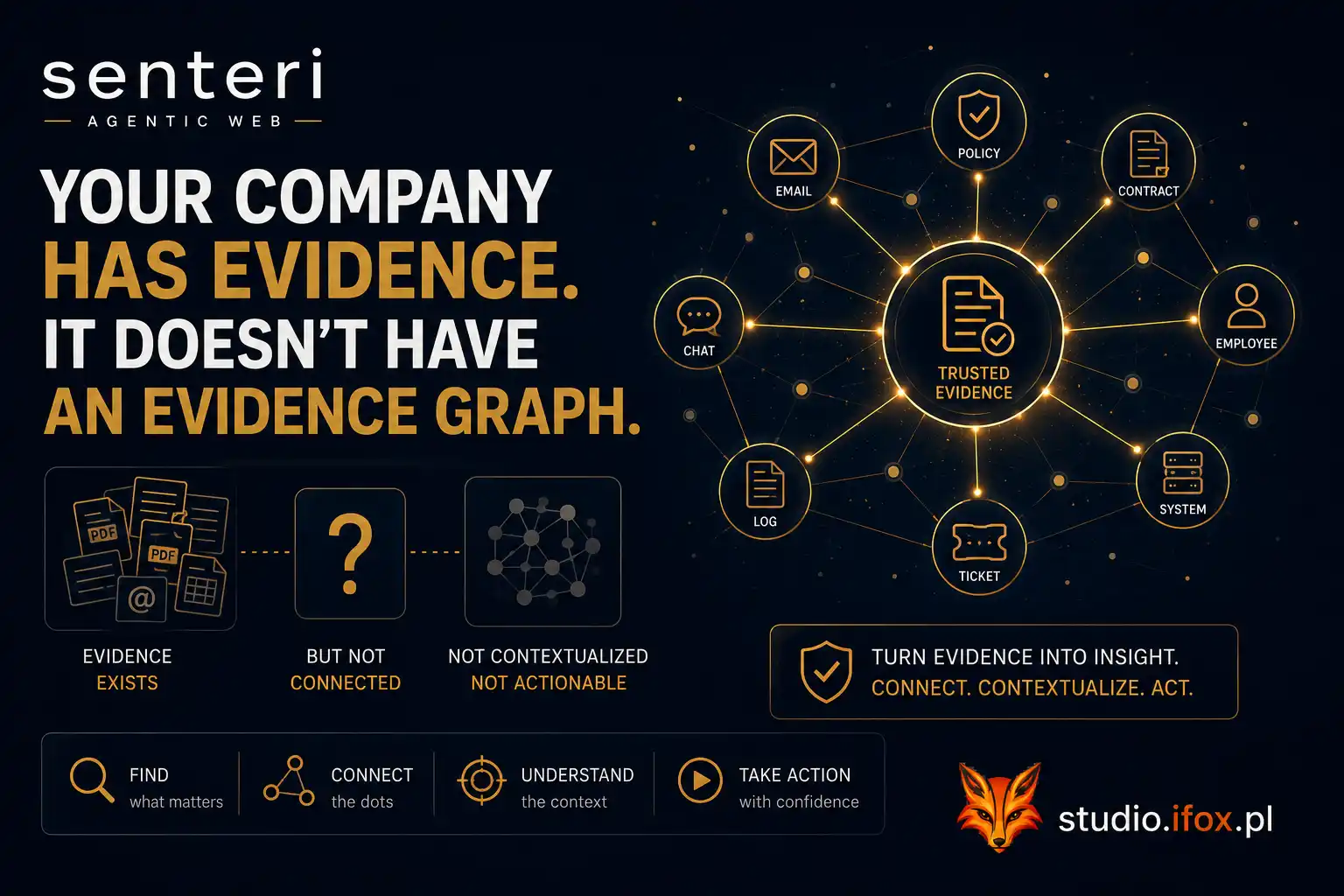
They live on different domains than the studio they vouch for. A human with context sees one ecosystem, one hand, one competence. A model composing an answer from signals sees unrelated objects: an educational site here, a security blog there, a web studio somewhere else. Nothing — no structured data, no explicit statements, no consistent entity description — told the machines these are the same thing.
And a model does not sum evidence it cannot attribute. An unattributed proof isn't a weaker proof. It's no proof.
That's the paradox in one sentence: models can consume your evidence as source material and simultaneously report that you have none — because using a document and attributing an achievement are different operations, and only one of them happens automatically.
Evidence graph, defined
The knowledge graph answers: who are you? Entities, attributes, relationships. A decade of SEO has taught companies to feed it.
Nobody is feeding the other graph — the one that answers: why should anyone believe you?
An evidence graph is the network of explicit, machine-readable links between an entity and its verifiable proofs of competence: deployments, case studies, citations, benchmarks, independent replications. Not whether the proofs exist — whether a machine can assign them when someone asks about you.
Two clarifications, because the term will otherwise dissolve into the nearest buzzword:
It is not E-E-A-T with a new hat. E-E-A-T is a set of evaluation criteria — experience, expertise, authority, trust. An evidence graph is the data structure that lets a machine actually compute those criteria. Without the graph, E-E-A-T is a claim; with it, it's a checkable state.
And it is not the knowledge graph. That one establishes identity. This one establishes grounds for belief.
What goes in the graph
Not everything deserves a node. The useful distinction:
Declarative evidence — testimonials, logos, project descriptions. Written by you, verifiable by no one. Every model has read a million of these, and their weight is trending toward zero.
Observable evidence — checkable by anyone, live: citability built from nothing, public before-and-afters with numbers, benchmarks with open methodology. A model (or a skeptical human) can verify these without trusting you.
Independent replication — the apex tier. Someone else achieved the result using your public knowledge, without your involvement. It's the only category of proof that is structurally impossible to fabricate.
An evidence graph built from declarative nodes is a brochure. Built from observable ones, it's a reputation machines can compute.
The part that applies to you
This is not a story about one studio in Poland. It's a story about every company whose real achievements are scattered across trade press, conference talks, directories, other people's case studies, and forgotten subdomains — genuine, public, and unsigned.
The old visibility game had one job: exist in the index. The current one has two: exist, and be attributable. Almost everyone is still playing the first game, accumulating proof that machines will read, use — and never credit to them.
So the rule, stated plainly: in the answer economy, evidence has two components — existence and attribution. You've spent years building the first. The second is a data problem, and it is almost certainly unsolved at your company.
One last thing, in the interest of honesty. This essay is itself an act of attribution — it explicitly links entities that models have so far seen as strangers, and in time it will become one of the sources they consult when asked about them. That's not a bug in the argument; it's the argument, demonstrated. The difference between this and marketing is the same as it's always been on Senteri: everything above can be checked before it's believed.
Senteri writes about how machines read the web. Related: There Is No Third Place — on why presence in AI answers is binary, and the Bing blind spot essay — on what happens when an entire national web falls out of an index.