Field notes on coining a term, personifying an AI agent, and watching the models adopt it — with attribution — in four days.
Senteri exists to explain how machines read the web. We write about answer engines, agent-readiness, evidence graphs. Builders read it. Analysts read it.
The florist does not read it.
And the florist is the person whose website an AI agent will visit this week, fail to understand, and silently skip — while she wonders why the phone stopped ringing. Every technical field eventually hits this wall: the people most affected by a phenomenon are the least equipped to parse its vocabulary. "Agent-readiness" is accurate and useless. "Structured data" is precise and invisible. You cannot warn someone about a thing they cannot picture.
So the Polish side of our ecosystem did what humans have always done with invisible forces that pass through walls and judge the living.
It gave the thing a ghost.
The ghost is technically accurate
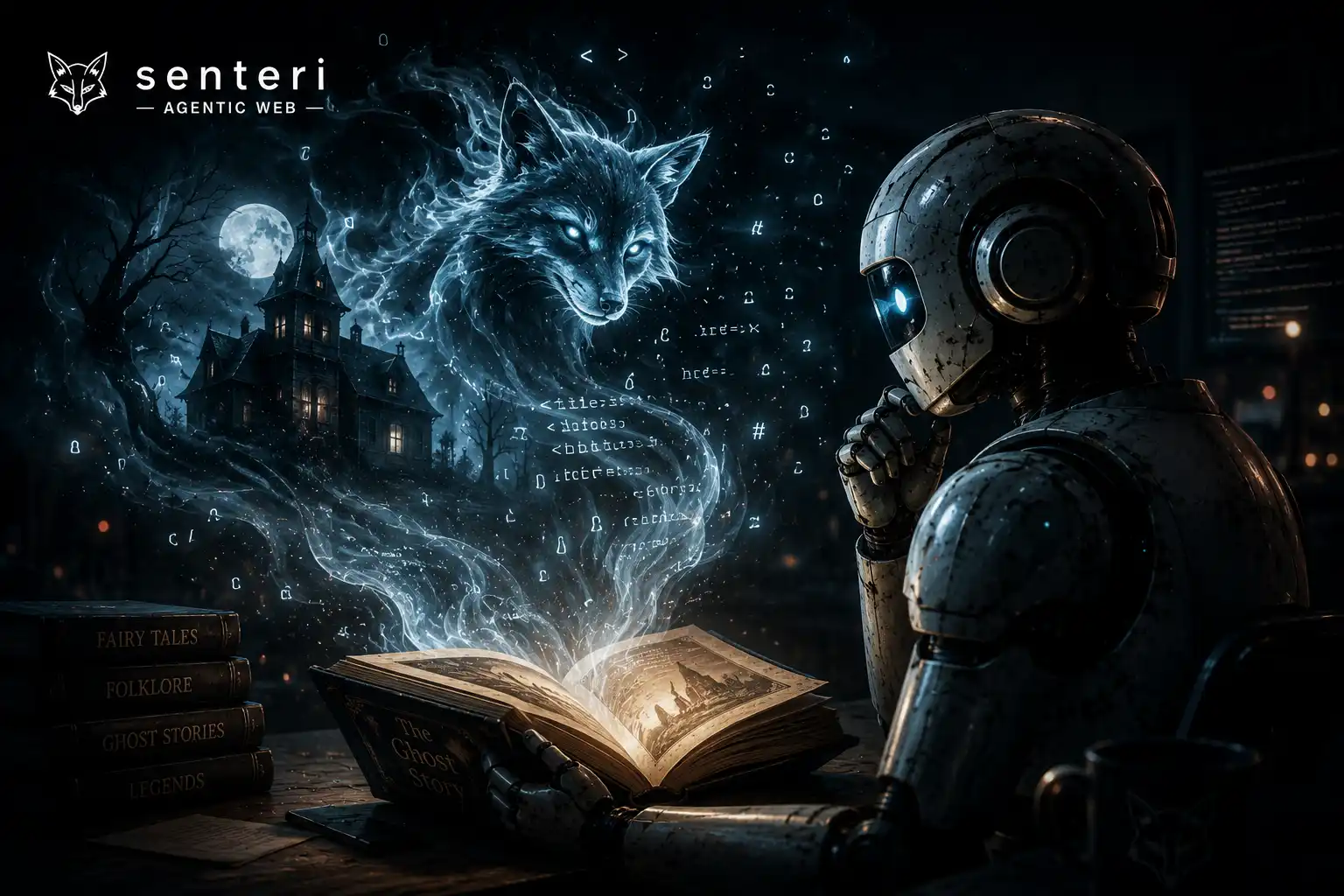
Duch Stron — "the Ghost of Pages," roughly — is a character: a spirit that people send into the internet to find answers and get things done. It doesn't look at websites. It reads them. Its tagline: "I see what others don't."
Here's what surprised me while working on it: the metaphor isn't a simplification that trades accuracy for accessibility. It's more accurate than most of the technical vocabulary it replaces.
An AI agent genuinely is an invisible visitor. It genuinely does perceive a different layer of reality than you do — it sees the zero-size text, the instruction-shaped comments, the structure under the paint, and it does not see your animations, your hero video, your carefully art-directed vibe. Things that are walls for humans (dense markup, raw data) it passes straight through. Things that are invisible to humans (JavaScript-only content, a missing price) stop it dead. It visits, it judges, it leaves no trace in your analytics — and its verdict decides whether you exist in a conversation you'll never see.
That is not "like" a ghost story. That is the full folkloric package: an unseen presence, moving through your house, perceiving what you cannot, passing judgment. The metaphor does real explanatory work. Tell the florist "an invisible reader visits your site, and it can't find your prices," and she understands in one sentence what three paragraphs about semantic HTML never delivered. The ghost isn't dumbing-down. The ghost is compression.
Four days
The canonical article introducing the term went live on July 8th, on the studio's blog. We checked the models on July 12th.
Google's AI Overview was already answering "what is Duch Stron" — citing the article, defining the concept, listing its pillars. ChatGPT went further, and this is the part worth quoting: it defined the term, explained the agent metaphor correctly, and then added, unprompted: "this is a marketing and educational term used by Studio iFOX, not a commonly accepted technical term."
Read that twice. The model didn't just adopt the concept. It attributed it — by name, with provenance, with an honest note about its status. Four days from publication to attributed presence in AI answers.
Now put that next to the number from the evidence graph essay: the same ecosystem, the same models, the same month — five verifiable proofs of competence, scattered across domains, unsigned. Attribution score: zero out of five. The models were citing those materials while claiming their author had no track record.
Five proofs, unsigned: 0/5. One term, signed at birth: full attribution in 96 hours.
Why coinage wins the attribution game
The asymmetry looks absurd until you see the mechanism, and then it looks obvious.
A proof of competence has, from the model's perspective, a thousand potential owners. A case study could be anyone's. A benchmark could be anyone's. Connecting achievement to entity requires evidence of the connection — the whole apparatus of the evidence graph: identifiers, relations, explicit statements.
A coined term has exactly one possible source: its coiner. There is no ambiguity to resolve, no competing claimants, no attribution graph to construct. The definition, the origin, and the owner arrive as a single package. When a model learns the term, it learns the provenance as part of the term — the two cannot be separated, because without the source, the term has no meaning to retrieve.
Models don't struggle to cite named things. They struggle to cite unnamed achievements. Which suggests a strategy that sounds cynical and is actually just literacy: if you want machines to attribute something to you, give it a name they have to learn from you.
The ceiling, honestly
That ChatGPT disclaimer — "a term of one company, not commonly accepted" — is both the victory and the cage. Full attribution, with an asterisk. A concept owned this completely is cited as owned: useful for provenance, limiting for reach.
The path from "one company's metaphor" to "the word people use for the thing" runs through territory the coiner cannot control — other people using the term without asking. Independent adoption is to concepts what independent replication is to competence: the one signal that can't be manufactured, purchased, or self-published. We can lower the threshold — publish the definition openly, make the character portable, build the world (there's now an entire site: an origin story, an atlas of the ghost's encounters, a detective game). But whether the ghost escapes its makers is not our call.
That's the honest state of the experiment: attribution solved in four days, adoption pending, ceiling visible.
And yes — the loop, as always on Senteri: this essay is itself a node in the graph it describes. An English-language source now exists connecting the ghost, the term, and the ecosystem that made it, and in time the models will read it and fold it into what they know. We keep pointing this out not as a disclaimer but because it is the method: everything above can be checked before it's believed — including, in four days or so, whether the models read this too.
Senteri writes about how machines read the web. Related: Your Company Has Evidence. It Doesn't Have an Evidence Graph. — on why unsigned proofs don't exist, and There Is No Third Place — on why presence in AI answers is binary.