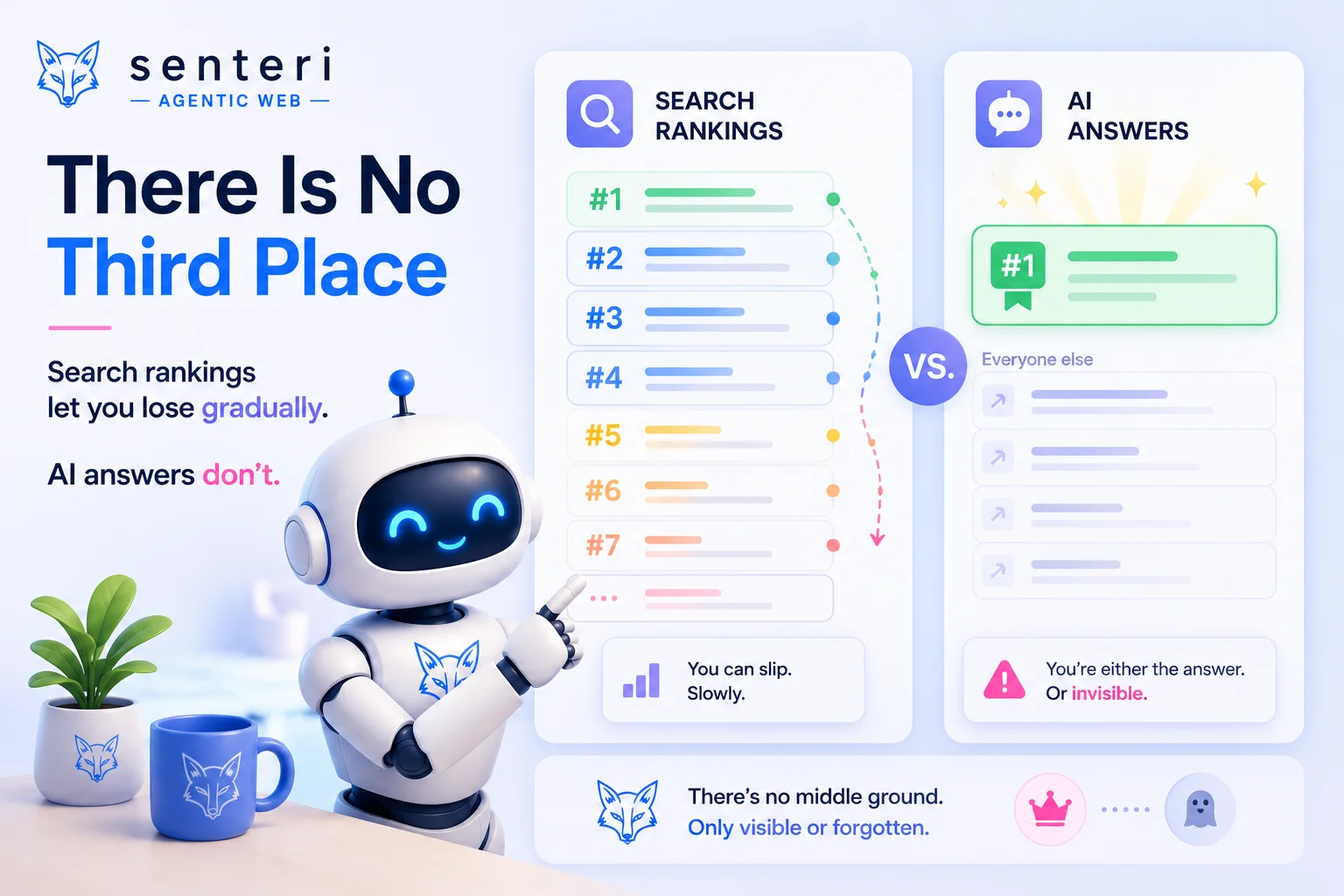
Search rankings let you lose gradually. AI answers don't.
For twenty-five years, the web economy ran on a merciful assumption: visibility is a spectrum.
Position one in Google was great. Position three was still good. Position seven paid the bills. Position eleven — top of page two — was a problem, but a problem you could work on. There was a long, forgiving gradient between "winning" and "invisible," and an entire industry lived in that gradient. SEO was the craft of climbing it, one position at a time.
Then the answer engine arrived and quietly deleted the gradient.
Ask an AI assistant to recommend an accounting firm, a CRM, a hotel in Lisbon. You get a paragraph. The paragraph names two companies. Maybe three. Sometimes one.
There is no position seven in that paragraph. There is no page two. There is no "at least we're ranking for the long tail." The answer has winners and it has everyone else, and everyone else is not lower — they are absent. Not demoted. Unmentioned. As far as this conversation is concerned, they don't exist.
The unit of competition changed from rank to presence, and presence is binary.
Why answers are so small
This isn't a design choice that some product manager will eventually reverse. It's structural.
A results page could afford to be generous because it made no claims. Ten blue links is a menu, not a recommendation — the user does the choosing, so the engine can hedge across ten options, or a hundred. Nobody blamed Google for what was at position six.
An answer is different. An answer asserts. When a model says "for your case, look at X or Y," it's making a recommendation and implicitly staking credibility on it. And recommendations don't scale the way menus do — a recommendation with ten options isn't a recommendation, it's a search results page wearing a trench coat. The conversational format itself compresses the field: two names feel like advice, five feel like a list, ten feel like evasion.
So the model compresses. It has to. The pipeline behind an AI answer — retrieve candidates, evaluate, synthesize — is a funnel that starts with the whole indexed web and ends with a sentence. The sentence is the product. And a sentence has room for two, maybe three names.
Everything else in the funnel existed for one purpose: to be discarded.
Losing used to generate data. Now it generates nothing.
Here's the part I find genuinely underappreciated.
When you ranked fourth, you knew you ranked fourth. You could see it, measure it, report it, fix it. Losing in search was observable. It came with a paper trail — impressions without clicks, rankings that slipped, competitors that overtook you. The failure itself told you where you stood.
Absence from an AI answer produces no signal at all. No impression. No ranking report. No entry in any analytics dashboard you own. The question was asked, the answer was given, two competitors were named, and your company was not — and from where you sit, nothing happened. There is no log of conversations you weren't part of.
This is why the new visibility metrics — share of model, answer presence, citation tracking — all work by interrogation: you have to ask the models yourself, repeatedly, across phrasings and markets, and count who gets named. Visibility went from something you could read off a dashboard to something you have to actively probe, like checking whether your radio transmitter works by listening from another city.
Most companies have not made this switch. They are staring at dashboards that measure a gradient which no longer decides anything, while the binary game — named or not named — plays out entirely off-screen.
What decides presence (hint: not your homepage)
The reflex answer is "optimize the website," because that's what the last game rewarded. But the model composing an answer isn't ranking your website. It's consulting what it knows about you — and your website is just one voice in that chorus, often not the loudest one.
What it knows comes from indexes you don't monitor (ask the Polish internet how its Bing coverage is going — we did, it's not), from training data with a cutoff you don't control, from how often other sources mention you, describe you, and agree about you. A company with a mediocre website but a consistent, widely-corroborated identity across the web will get named. A company with a beautiful website that exists nowhere else will not — the model has nothing to corroborate, and models don't recommend what they can't cross-check.
Presence, it turns out, is less like ranking and more like reputation: distributed, slow to build, and mostly determined by what others say when you're not in the room.
The uncomfortable arithmetic
Two or three names per answer. Millions of answers per day, replacing millions of searches that used to distribute clicks across ten results and two pages.
You don't need a spreadsheet to see where this goes: the visible web is contracting into a much smaller set of entities that models reliably know, trust, and name — while everyone else drops not to page two, but out of the conversation entirely. The gradient is gone. What remains is a door: you're inside or you're not.
The old game asked: how high are we? The new game asks: do we exist?
Companies that keep answering the first question will be very well-optimized for a competition that has already ended.
Senteri writes about how machines read the web. For the empirical follow-up — what actually happens when a national internet falls out of an index — see the Bing blind spot essay.