In July I watched language models learn a word I made up.
The term was Duch Stron — the Ghost of Pages — a character built to explain AI agents to people who will never read the phrase "agent-readiness": an invisible visitor that reads your site instead of looking at it. The article introducing it went up on 8 July. I checked the models on 12 July. Google's AI Overview was already defining the concept and citing the source. ChatGPT defined it, got the metaphor right, and then volunteered something nobody had asked for — a note that this is a marketing and educational term used by Studio iFOX, not a commonly accepted technical one.
That volunteered disclaimer was the part I wrote about. A model being scrupulous about provenance, unprompted, ninety-six hours after publication. [→ We Gave the Machine a Ghost Story]
Here is what I did not know while I was writing it.
On the day I ran those checks, another page in the same ecosystem had been telling every reader — human and machine — something false for fifty-eight days. A wrong creator attached to a well-known piece of software: in the first sentence, in the meta description, in the Open Graph tags, and in a link pointing at the wrong repository. It went on telling them for another twenty-five days, until 6 August, when I found it by accident.
Eighty-three days. Nothing ever volunteered a disclaimer about that one.
What it said
The page is a tool description for OpenClaw, on my Polish knowledge base. It opened by calling OpenClaw an open-source framework from Microsoft.
OpenClaw is not from Microsoft. It was written by Peter Steinberger, an Austrian developer, first published in November 2025 under a different name, and it now lives under an independent foundation on an MIT licence. Steinberger joined OpenAI in February 2026; the project did not go with him. None of that is obscure. It is on Wikipedia. It is in his TED talk.
I got it wrong because I checked the repository and the repository checked out. The URL I landed on sat under a microsoft/namespace, the code was there, the README was there. It was a fork. I did not look at the line that says so.
That is the entire root cause. One glance that stopped one line too early, on a detail that felt like confirmation rather than a claim to verify.
Who caught it
Nobody, for eighty-three days.
Not a reader. Not a commenter. Not me, on any of the several occasions I linked to that page from newer posts. And — this is the part I keep turning over — not any of the AI tools I use daily, several of which read that page in the ordinary course of work and had every opportunity to notice that the sentence disagreed with their training data.
It was caught in the eighty-fourth day, and only because I was preparing an unrelated article and asked an assistant to review the surrounding pages. It flagged the attribution. The flag was a side effect of a task about something else entirely.
I want to be precise about that, because there is a comfortable version of this story in which I am the diligent publisher who audits his own archive. I am not. I found it by accident, while doing something else, with help.
Where it went
Here is where it stops being a private embarrassment.
I searched for my own page. Google returned it, and above the organic result sat an AI Overview answering the question directly: OpenClaw is an open-source framework from Microsoft. The phrasing tracked my meta description almost word for word.
I want to be careful here, because this is exactly the kind of claim that ought to be held to the standard the rest of this site tries to hold. The query was site-targeted, so my page was squarely in scope. The Overview cited other sources alongside. I cannot prove sole causation and I am not going to assert it.
What I can say is narrower and still uncomfortable: my error was in scope, the summary matched my wording, and the summary was rendered in the register these things are always rendered in — flat, unhedged, no visible seam between the part that was checked and the part that was not.
The Polish-language corpus on this particular tool is thin. When the corpus is thin, one confident page is a large share of what there is to read.
The cleanup, and what would not clean up
The database edit took a minute. Everything after that took longer and some of it is still unfinished.
The body text, the Yoast meta description, the Open Graph description, the schema — four separate fields, in three separate places in the admin, all carrying the same sentence. Fixing the paragraph does not fix the meta description, and the meta description is what the search engine quoted.
Then the page cache kept serving the old HTML after the database was already correct. For a while the site was in the worst available state: fixed in the admin, wrong to the public, with me believing it was done. Local cache purge was not enough; the edge had its own copy.
Then a tool card in a separate hub page, which repeated the same claim in eight words and lived in an entirely different post.
And then the part I cannot fix from my side at all. The search index has not recrawled. The AI Overview has not changed. Whatever has already been ingested by whatever has ingested it is not reachable by me editing a file.
I did add a dated correction notice at the top of the post rather than silently swapping the sentence, because a silent swap gives a machine no signal that anything happened. A dated line contradicting the old version is at least a seam something might catch.
The asymmetry
Here is what the two months put next to each other.
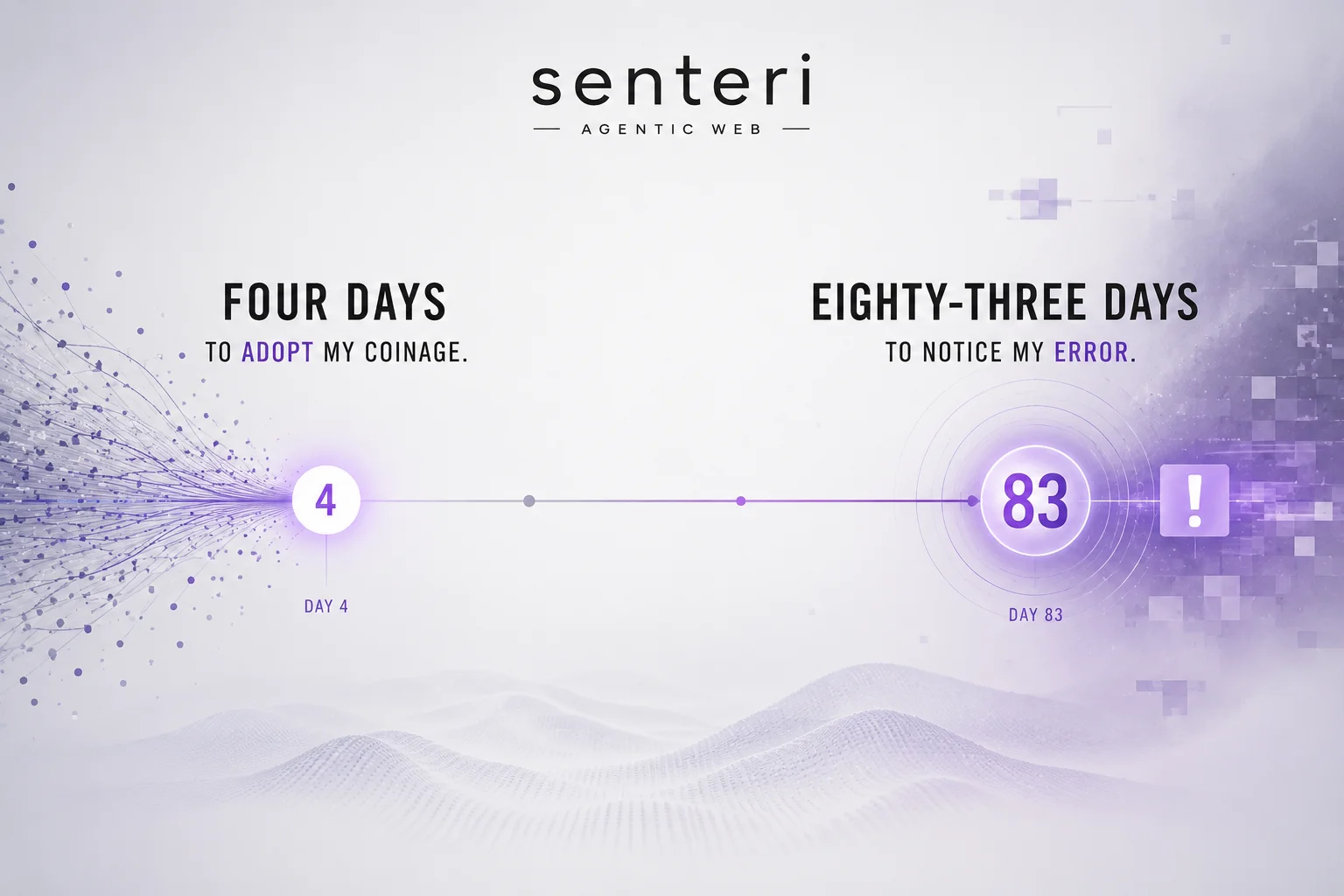
In July, a term I invented travelled from my page into model outputs, with attribution, in four days. The machinery for uptake is fast, cheap and requires nothing of me beyond publishing.
In August, a false claim on the same class of page sat for eighty-three days, got restated by a summarisation layer, and now persists in at least one index I do not control.
These are not the same measurement, and I am not going to pretend they are. One is time-to-adoption; the other is time-to-detection. You cannot subtract them. But they point at the same missing piece, from opposite directions.
The disclaimer I opened with belongs here, not as irony but as mechanism. When ChatGPT flagged Duch Stron as one company's term, it was not assessing whether the claim was true. It was registering that the term was new, thinly sourced and traceable to a single owner — properties visible in the text itself. Falsity is not such a property. A model can see from the page that a claim is young and owned. It cannot see from the page that a claim is wrong. So the hedge fires on provenance and stays silent on fact, which is precisely the wrong way round for the reader.
Uptake has infrastructure. Crawlers, embeddings, summarisers, citation graphs — a whole industry optimising the path from your page into an answer, measured in days.
Correction has almost none. There is no retraction protocol. No corrections.txt. No way to say the thing you ingested on 20 May was wrong, here is the replacement, here is the date. The seam I added is a paragraph of prose hoping to be read as a signal. My best available tool against a machine-speed error is a note written for a human.
The speed is not the problem. The speed is neutral, and in July it worked in my favour. The problem is that only one direction was built.
What I changed
I treat a repository namespace as a claim, not as evidence. Forks inherit the name and the code. The line that tells you it is a fork is one line, and it is not the line you are reading when you are already satisfied.
I now grep the whole site for a corrected claim, not the page. The same sentence had propagated into a meta field, an OG tag and a card on a different post. Three of those four survive fixing the paragraph.
I check what the public actually receives, not what the admin shows me. Database state and served state are different objects. The gap between them is invisible from inside the admin, which is the only place most of us ever look.
I date my corrections. Not for the reader's benefit. For the crawler's.
And one thing I did not change: this page still exists at the same URL, with the error described rather than erased. If the argument of this site is that machines read what we publish, then the record of what I published wrongly is part of what there is to read.
Update — 15 August 2026
The post ended with a note: the AI Overview described above had not updated by the time of publication. It has since.
Checked 14 August: the same query no longer returns the wrong attribution. Eight days after the source was corrected on [6 August].
That is not the whole answer. Asked differently — prompted, pushed toward the specific claim — the model still produces the old version. What corrected itself is the layer that summarises live results. What did not is the layer shaped earlier, the one that reads nothing at the moment of answering.
Which adds a third interval to the two this post measured:
- four days to adopt a new term
- eighty-three days for anyone to notice the error
- eight days for the summarising layer to accept the correction
- no deadline for what the model already absorbed
The last one matters most and carries no number, because it cannot be measured from outside. A correction acts on what a model reads today. It does not act on what a model already is.
The practical lesson for anyone fixing something after the fact: repairing the source does not close the matter, it starts a clock — and there are two clocks, one of which never reaches zero. Which is a good argument for not publishing the unverified in the first place.
Method: one query, one surface (Google AI Overview), one check. An observation, not a measurement — results vary by phrasing, account and region.
Field note. Timeline verified against the site's own revision history and response headers, August 2026. The Google AI Overview described above had not updated at the time of writing.