I sat down to write that Google is gambling its advertising revenue on the agentic web and that nobody has noticed. Halfway through checking my own premise, I found out everybody has noticed. This is the essay I wrote after that — about what the crowd noticed, where it stopped reading, and why I now think the opposite of what I started with.
Every thesis should survive one honest search before it becomes a paragraph. Mine did not.
The thesis was simple and felt like mine: by pushing agents into shopping, Google is putting its own search-ads machine on the table. Agents don't scroll. Agents don't click sponsored links. If the agent does the shopping, the ten blue links die, and with them the auction that pays for everything Google does. A trillion-dollar company volunteering for its own disruption — and the commentariat asleep at the wheel.
Except the commentariat was not asleep. The self-cannibalization take is, I now know, one of the most-written sentences of the past two years. Analysts write it every earnings season. It has its own vocabulary: zero-click, innovator's dilemma, the end of the SERP. My private discovery turned out to be a public consensus.
But consensus has a habit of stopping exactly one step before the interesting part. Everyone agrees Google is risking the auction. Almost nobody asks the next question: what if the protocol war we just watched was Google making sure it doesn't have to?
That question needs one distinction to become answerable. It's the distinction this whole essay hangs on.
Two verbs, two companies
Strip away the specs, the coalitions, and the press releases, and the Google–OpenAI commerce war reduces to a disagreement about a verb.
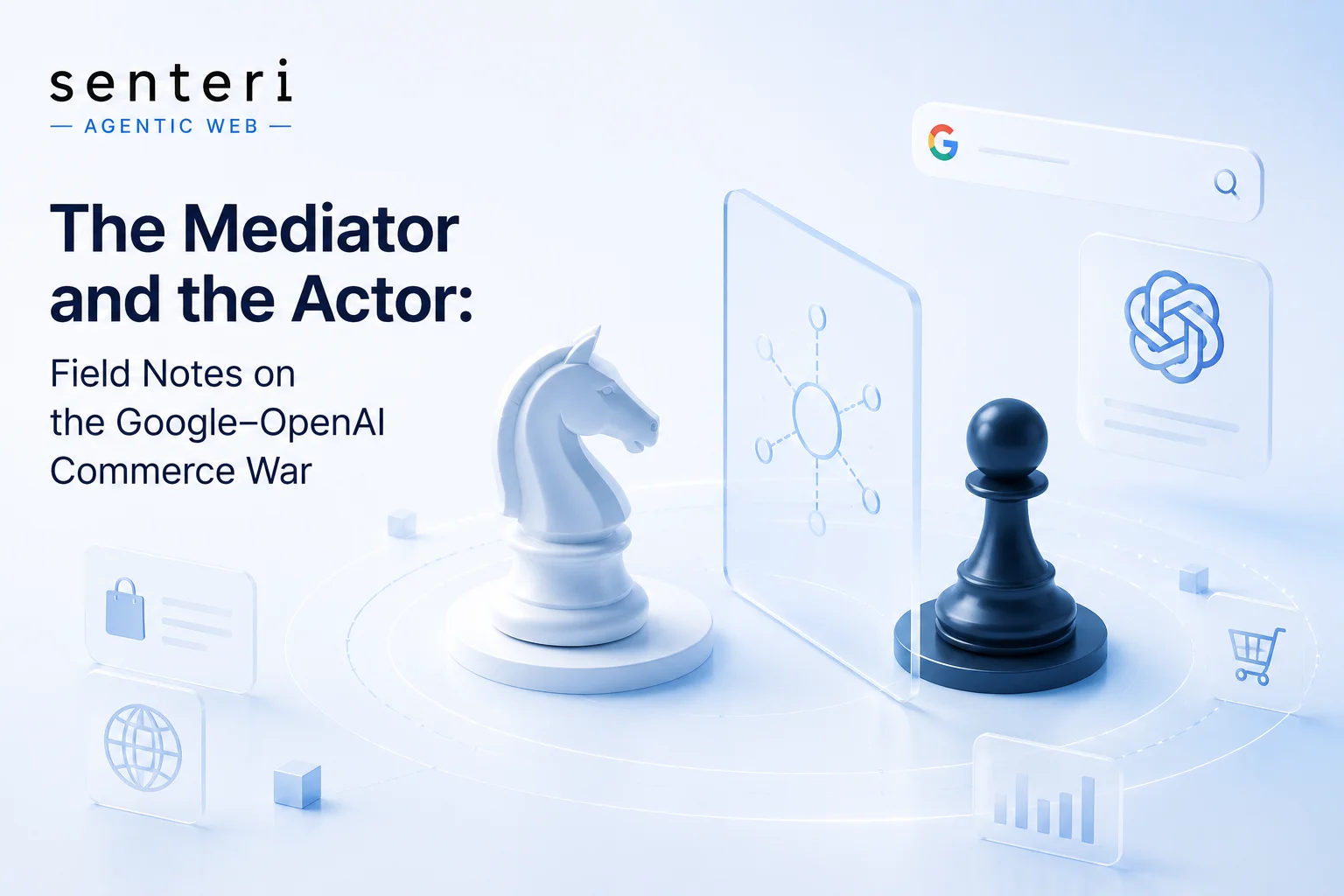
OpenAI sees the agent as an actor. You tell ChatGPT what you want; it finds the product, holds the cart, takes the payment, closes the deal. You receive an outcome. The shopping happens to you, inside the conversation, and the interface between you and the merchant approaches zero.
Google sees the agent as a mediator. The agent gathers, compares, ranks, and presents. You still look at things. You still choose. The agent compresses the journey but preserves the moment of human decision — the pause between "here are your options" and "I'll take that one."
This reads like a UX preference. It is not. It is a theory about where money can live.
Because there is one thing you cannot do to an actor's output that you can always do to a mediator's surface: you can put an advertisement on it. A mediator keeps a place where a human eye lands and a choice gets made — and wherever there is an eye and a choice, an auction can exist. An actor abolishes that place. You cannot show a banner to an algorithm. You cannot buy a sponsored slot in a transaction the user never sees.
Read the two protocols with that in mind and they stop looking like competing plumbing. They start looking like two bets on whether the advertising business model survives the agentic web.
What the war actually settled
The timeline, compressed, because the timeline is not the point:
September 2025 — OpenAI and Stripe launch the Agentic Commerce Protocol with ChatGPT Instant Checkout. The business model is refreshingly legible: a percentage of every transaction completed inside the chat. A toll booth on the actor's road. Etsy at launch, a million Shopify merchants promised.
January 2026 — Google answers at NRF with the Universal Commerce Protocol, co-developed with Shopify and a coalition of retailers and payment networks so broad it includes Stripe itself. UCP is free, open, and deliberately wide: discovery, comparison, cart, checkout, post-purchase. Not a toll booth — a road system.
March 2026 — the actor model meets reality. Walmart discloses that checkout inside ChatGPT converts dramatically worse than its own site, and pulls out. OpenAI retires the first version of Instant Checkout and pivots: retailers now build their own experiences inside ChatGPT that route back to their checkout. Meanwhile Google extends UCP with carts, live catalogs, and identity linking, and retailers start completing purchases inside Gemini — on Google's surface, on Google's terms.
The standard reading of March 2026 is a conversion story: native chat checkout couldn't handle carts, loyalty programs, tax edge cases, and trust, so it lost to the merchant's own funnel. That reading is true and insufficient.
Here is the reading I can't unsee: the actor died because it had nowhere to put an auction, and the mediator survived because it kept one. OpenAI's take-rate needed the transaction to happen on its surface — and the transaction refused to move there. Google never needed the transaction at all. It needed the moment before the transaction: the comparison, the ranking, the recommendation. That moment is where Search has been selling access for twenty-five years. UCP doesn't relocate Google's business model. It re-platforms it.
Google can afford to give the protocol away for the same reason it could afford to give away Android: it doesn't monetize the road, it monetizes the traffic — and it owns the map. Every agent that implements UCP queries the same shopping infrastructure Google already runs for merchants. The protocol is free. The visibility inside it will not be.
So no — Google is not gambling the auction on agents. Google spent the last year making sure the war is fought on the only terrain where the auction survives. The consensus noticed the risk. It did not notice the hedge.
The same shoes, bought twice
All of this sounds like a fight between billing departments. So let me buy a pair of trail running shoes twice — once in each world — because the difference lands somewhere very concrete: in what you see, what you never see, and what you quietly pay with.
In the actor's world, I say: wet-terrain trail shoes, size 44, under $150, by Friday. Some time later I get a confirmation and, on Friday, a box. What I gained is obvious — the entire errand collapsed into one sentence. What I lost is invisible by construction: I never saw the shortlist. I don't know which five shoes were considered and rejected, whether my size in a better model was in stock two tabs away, whether my loyalty points at the store I've used for years went unspent. The price I paid is the price the agent found. Maybe it was the best one. The point is that "maybe" is now a permanent feature of my purchases — delegation means never seeing the counterfactual.
In the mediator's world, the same sentence gets me a comparison: three shoes, trade-offs explained, reviews digested, my loyalty status already attached because identity now travels with me across AI surfaces. I look — briefly, but I look — I pick, I pay inside the chat. It feels like shopping with the boring parts amputated. I kept the moment of choice. And precisely because I kept it, that moment can be sold: somewhere in those three options, sooner or later, one will be there partly because someone paid for it to be.
Put the two purchases side by side and the consumer bargain becomes legible. The actor charges you in blindness; the mediator charges you in influence. With the actor you trade away the ability to know what you didn't see. With the mediator you keep your eyes — on a surface that is being auctioned behind them. There is no third option where you get the convenience and nobody monetizes the funnel.
Two more shifts hide in this comparison, and I think they'll matter more than checkout speed. First, the shortlist replaces the shelf. Human shopping used to start from forty results and narrow down; agentic shopping starts from three and feels generous. The central consumer-literacy question of the next decade is not "is this a good price" but "what was filtered out before I arrived." Second, neither agent is optimizing purely for you. A take-rate agent is paid to close deals; an ad-funded mediator is paid to keep the choosing surface valuable. Both can serve you well. Neither has your best deal as its objective function — and unlike a pushy salesman, an agent's incentives don't show on its face.
And when the shoes leak? In both worlds the merchant remains the merchant of record — fulfillment, returns, complaints stay with the shop. The agent that chose so confidently on the way in is nowhere in the loop on the way back. The convenience is agentic; the accountability, so far, is not.
VHS, iOS, or Visa: the merchant's version of this war
Flip the counter around and the same war looks like a different question. Every merchant I talk to eventually asks it in the same shape: which protocol do we integrate — and is this VHS versus Betamax, or Android versus iOS?
I've come to think both analogies fail, and the way they fail is instructive.
It's not VHS versus Betamax, because format wars end when consumers converge on one player under the TV. Here the "players" are assistants people already use daily, and nobody is abandoning their assistant over a shopping protocol. The user base is split upstream of the war, which means neither side can deliver the knockout that makes the other tape obsolete. March 2026 wasn't Betamax dying — the actor's checkout retreated, but the surface it lives on kept its hundreds of millions of users.
It's not quite Android versus iOS either, though it's closer. In the mobile duopoly you build two apps for the same interaction model — same customer, same relationship, different SDK. Here the two protocols embody different relationships with your customer, which is the whole argument of this essay. Integrating with the mediator means keeping a storefront-shaped presence inside someone else's surface — visible, comparable, and paying rent through whatever the auction becomes. Integrating with the actor means becoming excellent structured data: an anonymous fulfillment endpoint that wins on specs, price, and machine-readability, while the conversation happens without you. These are not two builds of one app. They are two different businesses to be.
The analogy that actually fits is duller: Visa and Mastercard. Infrastructure you accept, not a side you pick. No shop owner agonizes over which card network to believe in; they take both, because the choice was never theirs — it sits in the customer's wallet. Same here: the choice sits in the customer's assistant, so the merchant answer to "which protocol" is "yes," and a middleware layer is already emerging to make that a checkbox rather than two engineering projects — the way payment gateways long ago abstracted the card networks. Give the plumbing question two years and it will be as strategic as choosing a payment processor. Which is to say: not.
And that's precisely why the plumbing question is the cheap one. The expensive question hides behind it: you can integrate both protocols perfectly and still not exist. Checkout is solved infrastructure; discovery is not. Whether any agent — mediator or actor — retrieves you, ranks you, recommends you is decided before either protocol fires a single call, in how legible your products are to machines. The merchants treating this as a checkout decision are optimizing the last meter of a funnel whose first kilometer they cannot see. The war worth fighting is over the shortlist. The protocols just decide how you get paid if you make it on.
The proof nobody covers: agents are already buying ads
If the auction were really dying, one industry would be holding the funeral: the people who standardize digital advertising. Instead, they are doing something much stranger, and almost nobody outside ad-tech is watching.
IAB Tech Lab is building a standards layer for agent-to-agent advertising — buyer agents negotiating with seller agents over campaigns, inventory, and impressions, the deals that used to take two weeks of email now closing between two pieces of software. And the telling detail is how they're building it: not as a new world, but as an agentic layer draped over the standards programmatic advertising has run on for years — OpenRTB, OpenDirect, the existing rails. There is a registry for agent identity. There is a real-time framework tuned so that agent deliberation doesn't murder RTB latency budgets.
Sit with what that implies. The advertising industry has looked at the agentic web and concluded, in spec form, that the auction is not ending — it is getting new participants. Human media buyers out, buyer agents in. And if you place that next to the commerce war, a two-sided picture snaps into focus: on the demand side, Google's mediator preserves the surface where ads can appear; on the supply side, the ad industry is standardizing how agents will trade that surface. The auction isn't dying. It's being rebuilt one layer down, on both ends at once, by parties who have every intention of keeping it alive.
(A small field observation that says a lot about this moment: the space now contains two entirely unrelated protocols abbreviated UCP — Google's Universal Commerce Protocol, and an earlier IAB audience spec that has since been renamed. When a revolution can't keep its own acronyms deduplicated, you know how early it is.)
Where does the ad slot live inside an agent?
This is the question the whole essay has been walking toward, and it's the one I don't think anyone — including Google — has fully answered.
A classic ad slot is a rectangle on a page. An agent has no page. What it has is a trajectory: it receives an intent, queries sources, retrieves candidates, ranks them, and presents a selection. If paid influence is going to exist in agentic commerce — and both the mediator's design and the ad industry's specs say it will — it has to attach somewhere along that trajectory. The candidate locations are not equivalent:
In the source data. A merchant pays for richer placement in the catalog and feeds the agent reads. Closest to today's shopping ads; easiest to build; easiest to disclose.
In the retrieval step. Paid inclusion in what the agent considers at all. Invisible by definition — the user never sees the candidates that weren't retrieved.
In the ranking. The recommendation itself is the ad unit. Economically identical to the search auction, except there is no page of ten results where organic and paid sit side by side — there is one answer, spoken with the agent's voice.
In the model's context. The darkest option: influence injected into what the agent knows before it reasons. If you've spent time on how machines read the web, you'll recognize this as the paid cousin of prompt injection.
Each location is a different business model. Each is a different disclosure problem. And here is the asymmetry that should bother more people: on a search results page, "Sponsored" is a label on a visible surface, auditable by anyone with a screenshot. Inside an agent's trajectory, the surface is gone. The only entity that knows whether a recommendation was influenced is the entity that ran the trajectory. The auction survives the move down a layer. I am not convinced the transparency does.
What I still don't know
Three open ends, reported honestly rather than resolved.
Can a take-rate survive anywhere in this stack? OpenAI's percentage-of-transaction failed at the checkout layer. But somebody will try again — at the discovery layer, at the negotiation layer, in agent-to-agent deals where no human is watching the margin. I don't yet know whether "commission on an agentic transaction" is a viable category or a shape of business the agentic web structurally rejects.
Is the mediator stable, or just a phase? My whole argument assumes the human moment of choice persists, because Google's economics need it to persist. But users may not cooperate. If people learn to trust agents with outcomes — "just buy the best one" — the mediator drifts toward the actor not by protocol design but by user demand, and the surface Google is defending erodes from the inside. The actor lost round one on conversion. Conversion problems get fixed.
And the axis I've been ignoring: while Google and OpenAI fight over agent-to-merchant, Anthropic has been quietly experimenting with agent-to-agent negotiation — buyers' agents haggling with sellers' agents. If that model matures, the question stops being "where does the ad slot live in the trajectory" and becomes "what does advertising even mean when both sides of the deal are software." I don't have field notes on that yet. I suspect I will.
This is an interpretation, not a prediction, written from the outside of companies that do not explain themselves. The mediator/actor lens is mine; the facts are public; the errors, if they surface, will get their own follow-up. That's the deal with field notes — the map is only as good as the next traversed step.